

THE POWER BRIEF . MORNING EDITION
RBI minutes reveal divide over pace of further rate rises
The Power Brief | 22 October 2026 | Monetary policy, industry, air quality and trade
“to maintain price stability while keeping in mind the objective of growth.”
— Preamble to the Reserve Bank of India Act, as reproduced by the RBI
India’s monetary policymakers agree that inflation requires a response, but differ over how forcefully to signal the next steps. Minutes released on Wednesday put that debate alongside stronger industrial output and a fresh pollution-control intervention in Delhi-NCR. The Power Brief follows the evidence across monetary policy, industry, the environment and trade.
RBI weighs the pace of further tightening
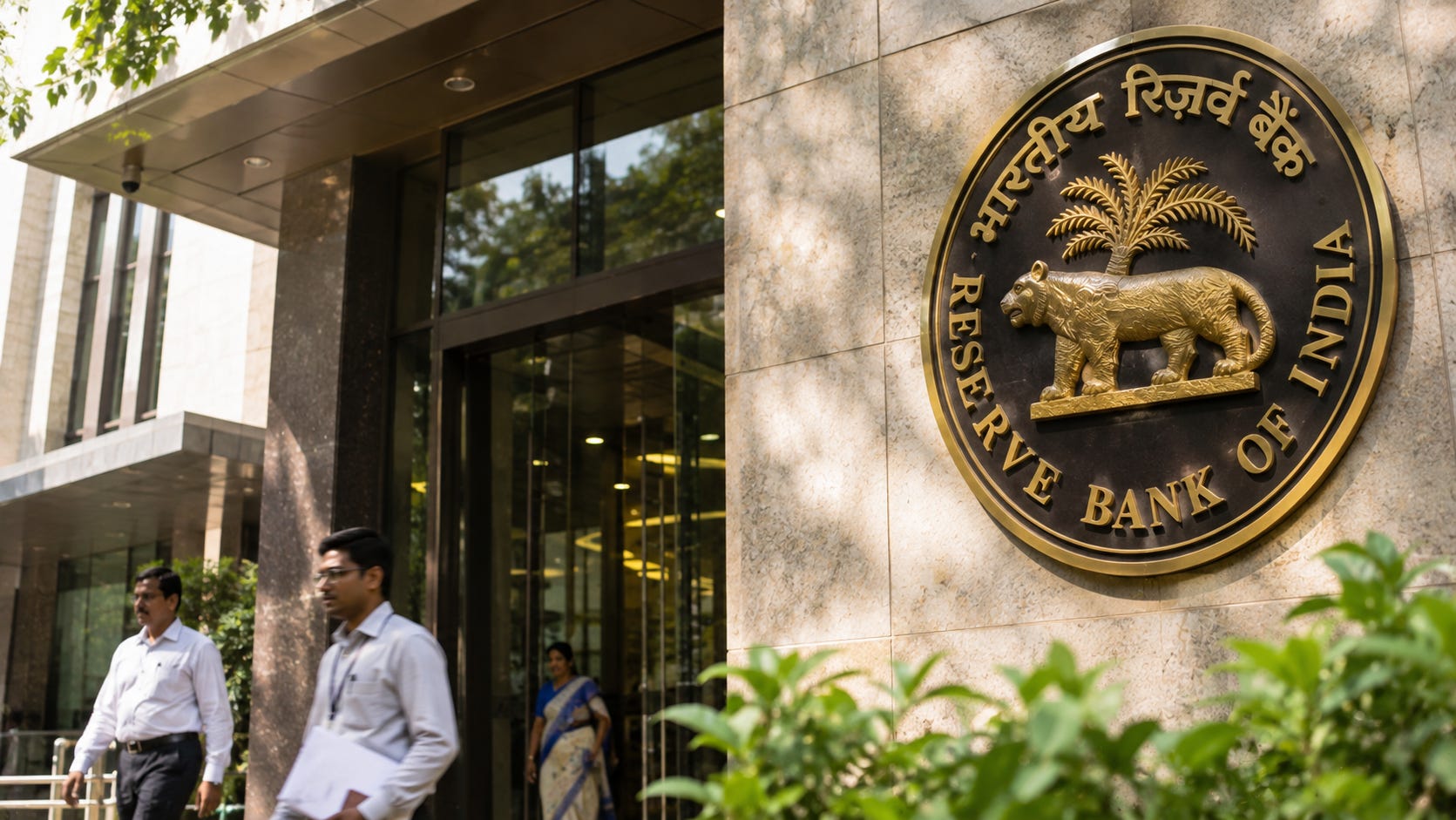
India’s rate-setting committee sees scope for further interest-rate increases, but its October meeting exposed differences over how much tightening the economy needs, according to minutes released on 21 October.
All six members supported raising the repo rate by 25 basis points to 5.50% at the 5–7 October meeting. A basis point is one-hundredth of a percentage point: the increase was 0.25 percentage points. Wednesday’s release explained that earlier decision; it was not a fresh rate increase.
Reuters reported that Governor Sanjay Malhotra saw signs of inflation spreading more broadly. Retail inflation reached 5.54% in September, while the RBI projected an average of 6% for October–December. Deputy Governor Poonam Gupta argued that policy operates with a delay and that another increase might be necessary.
The disagreement concerns the policy path. Business Standard reported that Nagesh Kumar and Ram Singh opposed changing the stance from neutral to calibrated tightening, despite supporting the rate increase. Singh warned that the wording could imply a longer tightening cycle than circumstances warranted. Saugata Bhattacharya supported tightening while cautioning against moving so quickly that growth suffered, Reuters reported.
The unanimous October rate vote leaves room for disagreement over subsequent decisions. The stance communicates the committee’s direction, but each subsequent decision still depends on incoming evidence. Readers should distinguish the actual policy rate, the committee’s guidance and private economists’ forecasts.
The next test is whether inflation becomes more widespread and how members weigh that evidence against economic activity. Neither a particular number of future increases nor a fixed peak rate follows automatically from these minutes.
Core industrial output accelerates
India’s core-industries output grew 7.9% from a year earlier in September, up from a revised 5.9% in August, Moneycontrol reported from the latest government release. The measure now covers nine infrastructure industries.
Iron ore production rose 18.4%, electricity 11.4%, coal 10.7% and refinery products 10.3%. Cement and steel also expanded. Natural gas, crude oil and fertilisers contracted, with fertiliser production down 11.7%.
For April–September, cumulative growth was 5.1%, compared with 2.5% in the corresponding period a year earlier. Moneycontrol described September’s reading as the strongest in the available series since April 2024; that qualification is more precise than calling it an all-time record.
The release offers evidence of stronger output in important supply industries, but the gains are not universal. It is an output index, not a direct measure of household purchasing power or the profitability of every manufacturer.
Subsequent revisions and broader industrial data will show whether the acceleration is sustained. One strong monthly reading is useful evidence, but should not be made to carry a claim about the entire economy.
Delhi-NCR activates pollution measures
The Commission for Air Quality Management invoked Stage I of the Graded Response Action Plan across the National Capital Region on Wednesday, after Delhi’s air quality moved into the poor category.
Akashvani reported an Air Quality Index reading of 244 at 2 p.m. on 21 October. The Indian Express reported that the preceding day’s reading was 179, in the moderate category. These are dated observations, not a live reading for Thursday morning.
Under the revised framework reported by the Indian Express, Stage I covers an AQI of 201–300. The commission directed implementing agencies to intensify measures and monitor compliance. The newspaper reported that schools and offices would continue functioning normally under this stage.
The distinction between stages matters. Stage I is not a shorthand for all restrictions available under the entire plan. Readers and businesses should check the operative directions relevant to their activity rather than assume that measures associated with more severe pollution have also been activated.
An emergency framework becomes meaningful through implementation: which sources are inspected, whether directions are followed and how the air subsequently changes. Invoking a stage is an administrative action, not evidence that pollution has already fallen.
Updated AQI observations and further commission orders will determine the next steps. Forecast poor conditions should remain labelled as forecasts; they are not measurements of what has already happened.
Goyal takes trade agenda to Europe
Commerce and Industry Minister Piyush Goyal is scheduled to visit Germany on 22–24 October and the Netherlands on 24–27 October, the ministry announced on Wednesday, according to The Statesman.
The programme includes the Berlin Global Dialogue, meetings with German officials and business engagements. In the Netherlands, discussions are planned with ministers in The Hague. Around 100 businesses and startups are expected to accompany the minister across the visit.
The reported agenda covers industrial and technological cooperation, investment and trade. Advanced manufacturing, clean technology and supply-chain relationships feature among the areas identified for discussion.
The visit provides a setting for commercial negotiations and investment contacts. A programme of meetings, however, is not the same as a signed agreement or completed investment. The useful test is what the participants subsequently announce, with identifiable commitments and implementation steps.
Official readouts will need to distinguish exploratory discussions, memoranda, firm orders and binding agreements. They describe different levels of commitment and should not be treated as interchangeable outcomes.
The day ahead
The four stories require four different kinds of attention. Minutes explain a policy decision already taken. An output release measures a past month and remains open to revision. A pollution order changes present administrative requirements. A travel announcement sets out intended engagements.
Keeping those distinctions visible helps prevent a familiar error: treating every newly published document as a new outcome. The right question is what changed in the world, what merely became known, and what is still proposed. We will follow the next evidence rather than assume the announcement has delivered its intended result.
Sources
1. Reuters, via WSAU — RBI minutes
https://wsau.com/2026/10/21/india-rate-panel-flags-more-hikes-but-wary-of-aggressive-cycle-minutes-show/
2. Business Standard — Committee members’ differences
https://www.business-standard.com/amp/industry/banking/rate-cuts-off-table-as-rbi-mpc-flags-inflation-risks-two-dissent-on-stance-126102101194_1.html
3. Moneycontrol — September core-industries output
https://www.moneycontrol.com/news/business/core-sector-output-growth-hits-30-month-high-of-7-9-in-september-driven-by-coal-power-14056876.html
4. Akashvani — GRAP Stage I
https://newsonair.gov.in/caqm-invokes-stage-i-grap-across-ncr-as-delhi-aqi-enters-poor-category/
5. The Indian Express — Delhi-NCR measures and scope
https://indianexpress.com/article/cities/delhi/delhi-grap-1-imposed-air-quality-deteriorates-10930732/lite/
6. The Statesman — Goyal’s European visit
https://www.thestatesman.com/business/piyush-goyal-to-visit-germany-the-netherlands-to-boost-trade-investment-industrial-cooperation-1503653522.html
7. Reserve Bank of India — Preamble and functions
https://www.rbi.org.in/scripts/AboutusDisplay.aspx

The next briefing, in your inbox
The Raisina Post’s Editorial Desk sends a clear account of the decisions, data and global moves shaping India each morning. Subscribe free, or share this edition with someone who follows the story.