

THE POWER BRIEF . MORNING EDITION
India makes room for E100 vehicles, but existing cars are not cleared for it
The Power Brief | 28 October 2026 | Flex fuel, toll passes, BRICS and Cyclone Arnab
“Vehicles certified for these fuels must meet the emission and safety requirements applicable to their category.” — Ministry of Road Transport and Highways, 26 October 2026
India has opened a regulatory path for vehicles certified to run on high-ethanol fuel, including E100. The change concerns vehicle approval; it is no instruction to pour a new fuel into cars already on the road. A new local toll pass, a BRICS declaration and Cyclone Arnab’s approach also matter this morning.
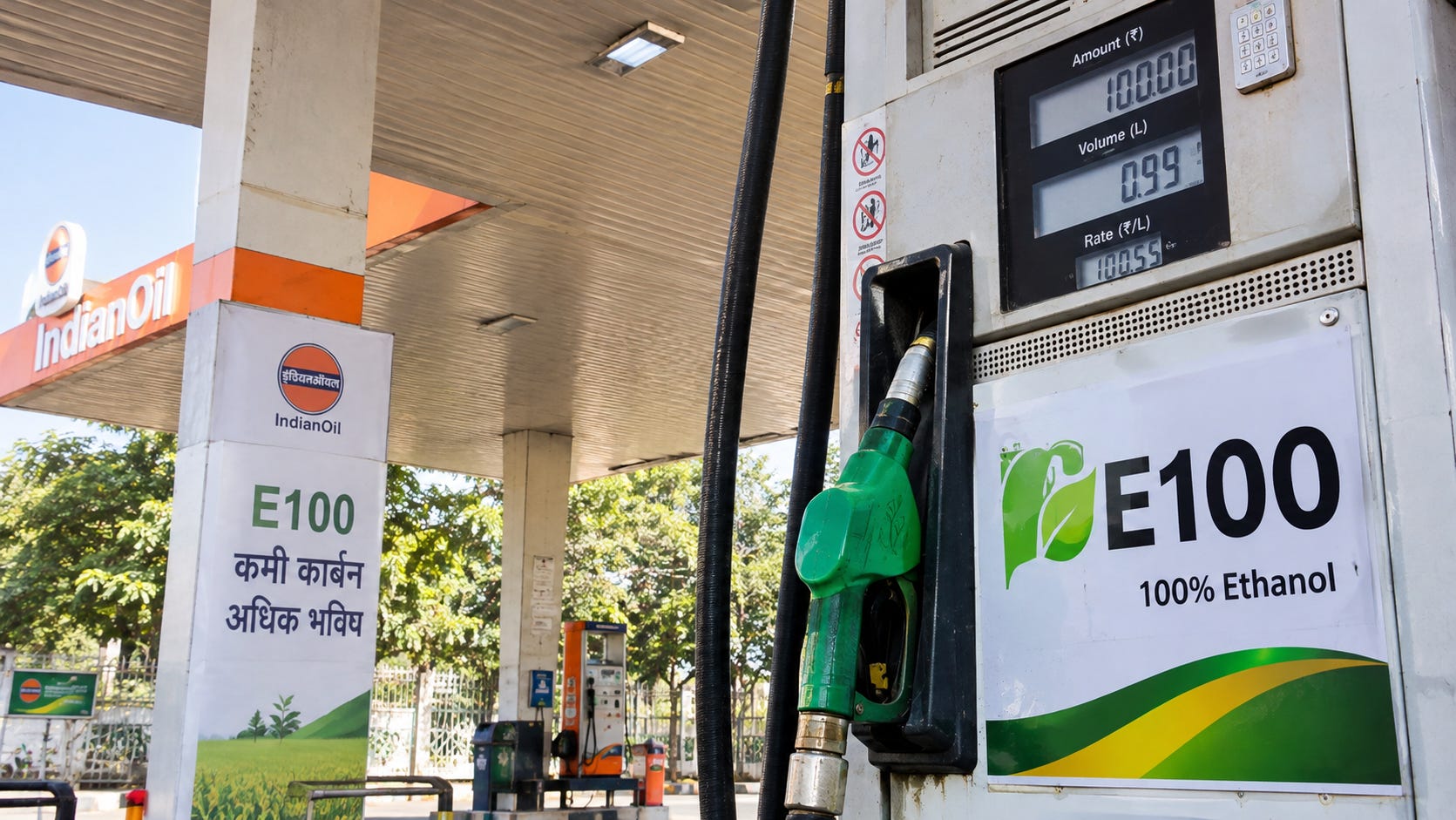
A route to E100, with a clear limit for existing cars
The Road Transport Ministry says it has amended the Central Motor Vehicles Rules to expressly include E100 alongside E85 in emissions certification for flex-fuel vehicles. E85 contains up to 85% ethanol by volume. A flex-fuel vehicle is built to operate across a declared range of petrol-ethanol blends; its fuel-system materials and engine controls have to suit that range.
The distinction between permission and availability matters. The notification establishes a route for manufacturers to certify vehicles. It does not show that E100 cars are already on sale at scale, that pumps will stock the fuel nationwide, or that owners of current petrol cars must convert them. The ministry explicitly says a car approved for E10 or E20 is not thereby suitable for E85 or E100. Drivers should follow the compatibility sticker and owner’s manual.
The government presents domestic ethanol as a way to reduce dependence on imported crude. It also says emissions benefits depend on the crop or other feedstock and on how the fuel is produced. Those qualifications are central: a tailpipe comparison alone cannot settle a fuel’s full environmental impact. For buyers, the practical question is which vehicles receive certification and where a compatible fuel can actually be bought. The rule takes effect on publication in the Official Gazette, according to the ministry.
What to watch: manufacturer certifications and fuel availability, rather than treating the rule change itself as a nationwide switch.
A new toll pass is limited to one plaza
From 1 November, eligible owners of non-commercial vehicles who live within 20 kilometres of a National Highway fee plaza can choose a concessional annual local pass. The government has set the price at ₹1,500 for plazas outside municipal or local-town limits and ₹3,000 for those inside them.
The pass requires a valid, functioning FASTag. It applies to the specific plaza for which it is issued and cannot be transferred to another. Residents may choose it instead of the existing monthly pass, but the cheaper annual option will not be available on highways or expressways using a closed user-fee system. The ministry also excludes places where a service road or alternative road is available.
That last pair of exclusions makes the headline price an incomplete guide to eligibility. A driver who lives within the distance limit may still be refused if the plaza or route falls into an excluded category. The ministry says eligible plazas will issue the pass from 1 November, while the Rajmargyatra app will offer it from 1 December. Rates can be revised annually, with changes taking effect on 1 April.
What to watch: the eligible-plaza list and the documents operators require to prove local residence.
BRICS parliaments adopt a declaration, not a binding law
Parliamentary representatives from BRICS countries adopted a joint declaration at their New Delhi forum on 27 October. The text backs cooperation across political, economic and cultural areas, calls for a stronger voice for the Global South in international parliamentary bodies, and discusses digital technology and sustainability. It also records proposals for further working groups and exchanges.
The important distinction is institutional. A parliamentary forum can articulate common priorities and create channels between legislatures. Its declaration does not itself amend Indian law or commit every member government to a single new policy. The document says legislative support operates within each parliament’s constitutional powers. That caveat should guide how its pledges are read.
India hosted the meeting during its 2026 BRICS chairship; the declaration looks ahead to China’s chairship in 2027. The test for this forum will be whether its proposed cooperation produces identifiable parliamentary work, such as committee exchanges or public documents, rather than more declarations alone.
Arnab was close to the Andhra coast at 5.30 a.m.
At 5.30 a.m. IST on 28 October, the India Meteorological Department located very severe cyclonic storm Arnab about 30 kilometres east of Narsapur and 45 kilometres south-southwest of Yanam. In an 8.24 a.m. bulletin, it said the storm was expected to cross the Andhra Pradesh and Yanam coast near south of Yanam within two hours, with sustained winds of 115–125 kilometres an hour and gusts to 140 kilometres an hour.
This is a time-stamped forecast, not confirmation of landfall. Conditions can change quickly, and the latest IMD and local administration warnings should take precedence over any morning newsletter. Yesterday’s briefing covered preparations; today’s new fact is the storm’s much closer position and the shorter forecast window. The bulletin describes very rough to high seas in the west-central Bay of Bengal and poor visibility in heavy rain.
What to watch: IMD’s confirmation of the crossing, district-level alerts and subsequent assessments of damage. No casualty or damage figure is included here without official confirmation.
Oil purchasing remains a price question, minister says
At an energy industry event in Goa on 27 October, Petroleum Minister Hardeep Singh Puri said India had faced no US pressure to cut Russian crude purchases. Reuters reported his comments and his account that refiners had bought more discounted Gulf oil as the relative economics changed. His statement describes the government’s position; it does not independently establish every diplomatic exchange.
For India’s refiners, origin is only one part of the calculation. Delivered price, freight, insurance, payment arrangements and refinery suitability determine what a barrel is worth. The recent shift towards Middle Eastern crude therefore should not be read on its own as proof of a lasting political decision. The next evidence will be sustained import data and company disclosures, not a single month’s cargo mix.
The day ahead
The immediate public-service priority is the next IMD bulletin on Arnab and any state advisories after the expected crossing. For the two road-transport changes, readers should check the final rules and implementation notices: the flex-fuel amendment is a certification framework, while the local toll pass starts at eligible plazas on 1 November. Those are different kinds of policy change, with different tests of whether they work in practice.
Sources
Road Transport Ministry, flex-fuel rule, 26 October: https://www.pib.gov.in/PressReleaseIframePage.aspx?PRID=2328642&lang=2®=48
Road Transport Ministry, local toll pass, 27 October: https://www.pib.gov.in/PressReleasePage.aspx?PRID=2329077&lang=2®=48
Lok Sabha Secretariat, BRICS parliamentary declaration, 27 October: https://www.pib.gov.in/PressReleseDetailm.aspx?PRID=2329065&lang=1®=3
India Meteorological Department, sea-area bulletin issued 8.24 a.m. IST, 28 October: https://mausam.imd.gov.in/Forecast/seaarea_bulletin_new.php?id=0
Reuters, Puri’s remarks on crude imports, 27 October: https://live.euronext.com/en/financial-news/no-pressure-us-cut-russian-oil-imports-indian-oil-minister-says

The next briefing, in your inbox
The Raisina Post’s Editorial Desk sends a clear account of the decisions, data and global moves shaping India each morning. Subscribe free, or share this edition with someone who follows the story.