

THE POWER BRIEF . MORNING EDITION
Sensex jumps 2,009 points as falling oil prices lift Indian markets
The Power Brief | 6 November 2026 | Indian equities, critical minerals, bank lending and social media regulation
Indian equities recorded their strongest session in seven months on Thursday, with the Sensex gaining 2,008.61 points as crude oil prices fell and foreign investors returned to domestic shares. The government launched auctions for 20 critical mineral blocks, while the Reserve Bank of India published draft revisions to priority-sector lending regulations. Separately, reports that the IT Ministry is considering changes to social media companies’ legal immunity raised questions about the future regulation of digital platforms. ¹ ³ ⁴ ⁶
“The change, built into the Tender Documents for both tranches, addresses a key reason blocks have gone unsold.” — Ministry of Mines, 5 November 2026. ³
Thursday’s developments reflected different pressures on the Indian economy. Lower international oil prices offered immediate relief to financial markets, even as security threats persisted in the Strait of Hormuz. The mineral auctions and lending proposals concern longer-term investment and access to credit. The reported discussions on social media liability remain preliminary, with no enacted change to the governing law.
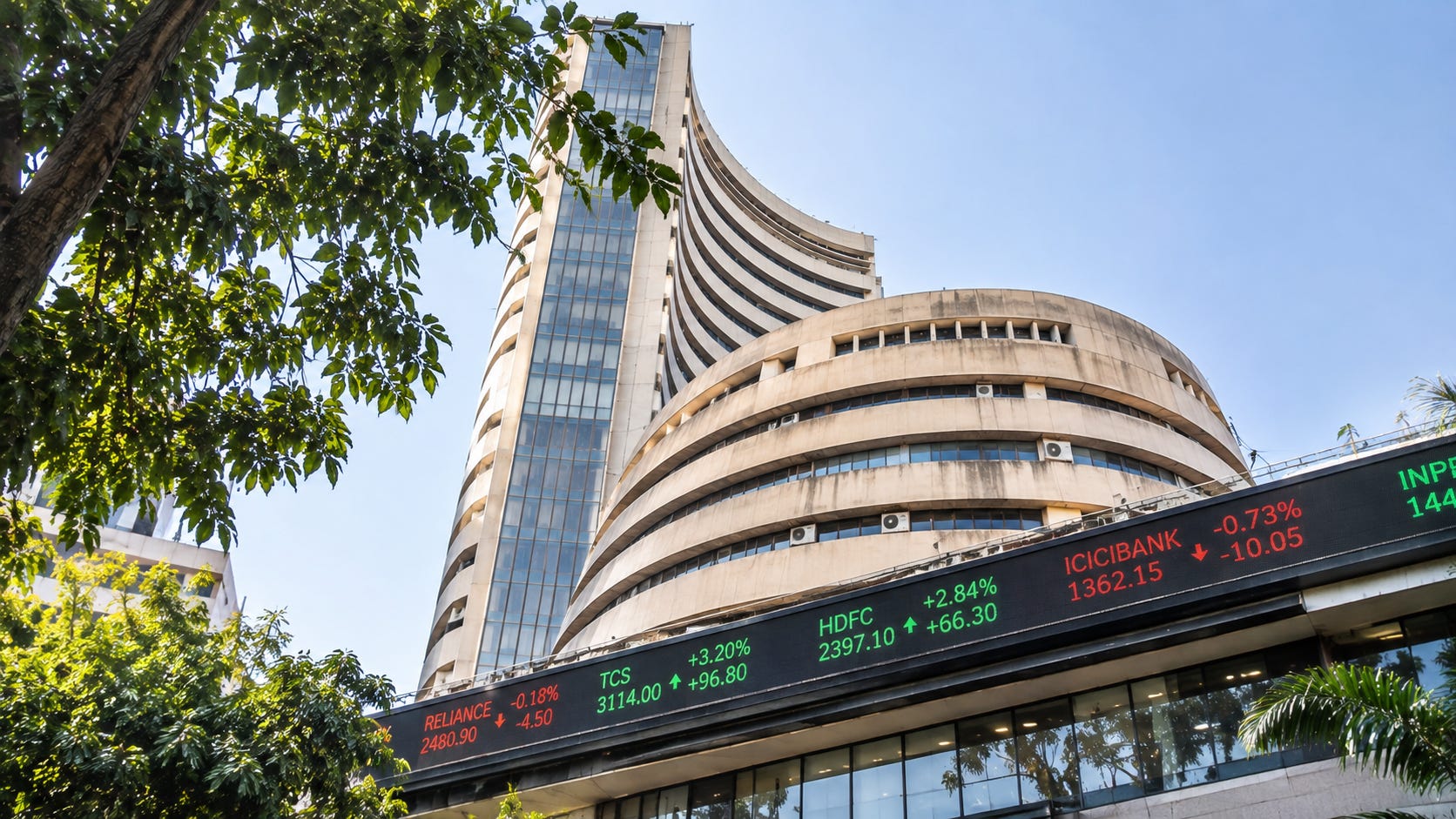
Indian stocks record biggest rally in seven months
Key facts: Sensex 79,310.01, up 2.60%; Nifty 50 24,536.60, up 2.40%; six consecutive sessions of gains; Brent crude fell below $100 a barrel during Thursday’s trading. ¹ ²
Indian benchmark indices extended their rally on 5 November, supported by falling crude prices, substantial foreign investment and expectations that political developments in the United States could alter the course of the Iran conflict.
The Sensex climbed 2,008.61 points to close at 79,310.01, while the Nifty 50 gained 576 points to finish at 24,536.60. Both benchmarks have risen more than 8% over six consecutive sessions.
Banking, finance and automobile shares were among the beneficiaries. Bajaj Finance advanced approximately 7.7%, while other financial companies also recorded strong gains.
The movement in crude prices was particularly relevant to India, which imports most of the oil it consumes. Lower prices can reduce import costs and ease pressure on the current account, inflation and corporate margins.
Foreign investors also returned to Indian equities in substantial numbers. Reuters reported net purchases of approximately ₹15,000 crore on Thursday, the strongest single-day institutional inflow in nearly six years.
However, the decline in oil prices does not mean the underlying geopolitical risks have disappeared. Reuters reported further attacks involving tankers in the Strait of Hormuz, alongside continuing diplomatic efforts involving the United States and Iran. ⁸
Analysis: Lower energy costs and renewed foreign buying have improved market sentiment, but the rally remains sensitive to international developments. Sustained gains will depend partly on corporate earnings and whether the improvement in capital flows continues.
Next milestone: Friday’s trading session will test the durability of the rally. Pre-market indications suggested a weaker opening amid a broader decline in Asian equities.
India opens 20 critical mineral blocks for auction
Key facts: 20 mineral blocks offered across eight states; 11 additional exploration-licence blocks; 64 successful auctions out of 100 blocks offered in the previous eight rounds; technical bidder requirement reduced from three to two for specified mineral categories. ³
The Ministry of Mines launched its ninth round of critical and strategic mineral auctions on Thursday, offering blocks containing graphite, rare earth elements, vanadium, gallium, titanium, tungsten and other industrially important minerals.
The auction covers eight states, including Chhattisgarh, Rajasthan, Maharashtra, Telangana and West Bengal.
The government also introduced a third round of exploration-licence auctions, allowing private participants to undertake exploration before commercial mining begins.
A significant procedural change concerns the number of bidders required for certain mineral auctions to proceed.
Under rules notified in October, the minimum number of technically qualified bidders in the relevant second-round process has been reduced from three to two.
The Ministry acknowledged that insufficient bidder participation had contributed to previous unsuccessful auctions. Only 64 of the 100 distinct mineral blocks offered during the first eight rounds were successfully auctioned.
The latest change is intended to make the process more viable for investors. The minerals involved are used in electric vehicles, renewable-energy equipment, electronics, defence manufacturing and other industries.
Analysis: India is attempting to attract more private investment into exploration and mining. But allocating a mineral block does not establish that commercially recoverable deposits exist or that production can begin quickly. Geological assessment, environmental approvals, financing and processing capacity remain important constraints.
Next milestone: Tender-document purchases close on 1 January 2027, with technical bids and initial price offers due on 7 January.
RBI proposes five new priority-sector lending directions
Key facts: Five draft directions issued on 5 November; separate frameworks for different banking categories; commercial banks’ broad priority-sector target remains 40%; public feedback closes on 26 November. ⁴ ⁵
The Reserve Bank of India has proposed reorganising its priority-sector lending regulations into five separate frameworks covering commercial banks, small finance banks, regional rural banks, local area banks and urban cooperative banks.
Priority-sector lending requirements direct a prescribed share of bank credit towards specified activities such as agriculture, smaller businesses, education, housing and other eligible sectors.
The proposed directions retain the principal lending targets while consolidating instructions that have accumulated through successive regulatory amendments.
Commercial banks and local area banks would continue to face an overall target of 40% under the proposed framework, while other categories have different requirements.
The drafts also address eligibility and classification provisions affecting loans for agricultural infrastructure, food processing and other qualifying activities.
According to the RBI, instructions omitted from the consolidated framework would be repealed after the final directions are issued, subject to a separate notification.
The proposals are open for consultation and do not yet replace the existing rules.
Analysis: Consolidation could make regulatory requirements easier for banks to interpret and administer. The final effect on borrowers will depend on which eligibility provisions are retained, modified or removed. It would be premature to describe the exercise as a general expansion of credit availability.
Next milestone: Comments must be submitted by 26 November through the RBI’s consultation channels. Final directions will determine the operative requirements.
Government weighs changes to social media platforms’ legal protection
Key facts: Discussions reported on 5 November; Section 79 of the Information Technology Act under consideration; algorithmic ranking and recommendation systems central to the reported debate; no final decision or enacted amendment. ⁶
The Ministry of Electronics and Information Technology is examining whether major social media platforms should continue receiving the same legal protection from liability for user-generated content as services that primarily transmit information, according to reporting by The Indian Express and Business Standard.
Section 79 of the Information Technology Act provides intermediaries with conditional protection against liability for material posted by third parties.
The provision does not establish unconditional immunity. It requires intermediaries to satisfy specified conditions, including applicable due-diligence obligations.
The reported discussions concern platforms that use algorithms to rank, recommend, promote or suppress content.
Officials cited anonymously in the reports argued that such activities may make social media services more active participants in determining what users encounter, rather than merely passive carriers.
Removing or narrowing existing protections could have significant consequences for companies operating services such as YouTube, Instagram, Facebook and X.
However, the discussions remain exploratory. No final proposal, legislative amendment or formal public consultation establishing the reported approach was identified at the information cutoff.
Analysis: The issue concerns how liability should be allocated between users who create content and platforms that distribute it. Any legislative change would need to address unlawful content while preserving workable protections for legitimate expression and ordinary platform operations.
Next milestone: An official policy paper, consultation or proposed amendment would provide the first basis for examining the government’s precise legal approach.
The day ahead
6 November — Indian markets: The Sensex and Nifty enter Friday after six successive sessions of gains. Global technology stocks and Asian markets weakened overnight, making the opening session important for assessing whether Thursday’s rally holds.
6 November — RBI: The Reserve Bank is expected to publish its weekly foreign-exchange reserve figures and conduct scheduled market operations.
6 November — Government securities: A ₹36,000-crore government securities auction is scheduled.
6 November — Mining ministers’ conference: The second day of the conference in Goa will continue discussions on mineral exploration, investment and state-level implementation.
12 December — Election Commission case: The Supreme Court is scheduled to revisit petitions challenging legal immunity for the Chief Election Commissioner and Election Commissioners. The Court has sought responses but has not ruled on the constitutional question. ⁹
Explore The Raisina Post
Market Desk — Indian equities, currencies and commodity reference data.
Policy Monitor — Regulatory developments and official notices.
India in Data — Economic indicators and historical comparisons.
Sources
Reuters, Indian Stocks Set for Pullback After Sharp Rally on Oil Slide and Foreign Inflows, 6 November 2026. Read
Financial Express, Sensex Ends Over 2,000 Points Higher, Nifty Posts Major Gains, 5 November 2026. Read
Ministry of Mines / Press Information Bureau, Ninth Tranche of Critical Mineral Auctions and Third Tranche of Exploration Licence Auctions, 5 November 2026. Official release
Reserve Bank of India, Consolidation of Instructions Related to Priority Sector Lending — Drafts for Comments, 5 November 2026. Official release
Economic Times BFSI, RBI Reviews Priority-Sector Lending Framework, 5 November 2026. Read
The Indian Express, Government Looks at Scrapping Legal Immunity for Social Media Platforms, 5 November 2026. Read
Business Standard, Government Weighs Removing Blanket Protection for Social Media Platforms, 4 November 2026. Read
Reuters, Tankers Hit in Hormuz as Iran Keeps Up Pressure After US Vote, 5 November 2026. Read
Hindustan Times, Supreme Court Seeks Centre, ECI Reply in Plea Against Election Commissioners’ Legal Immunity, 5 November 2026. Read
Information cutoff: Approximately 9:00 a.m. IST, 6 November 2026.
Reporting note: This briefing draws on primary government and regulatory publications, published financial data and attributed reporting. The reported social media policy discussions have not been independently confirmed through a formal government proposal. Market movements are reported as historical closing figures, not predictions.

The next briefing, in your inbox
The Raisina Post’s Editorial Desk sends a clear account of the decisions, data and global moves shaping India each morning. Subscribe free, or share this edition with someone who follows the story.