

THE POWER BRIEF . MORNING EDITION
Centre doubles rice-sale target to 50 lakh tonnes as prices rise
The Power Brief | 7 November 2026 | Food prices, semiconductor manufacturing, Indian markets and US–Iran diplomacy
India doubled its target for open-market rice sales to 50 lakh tonnes on Friday and made weekly stock declarations compulsory for traders and processors, extending measures intended to contain rising food prices. The government also opened applications under Semicon 2.0 and approved 12 electronics-component manufacturing projects. Indian equities completed their strongest week in nearly six years, while reports of renewed diplomatic proposals between Iran and the United States brought attention back to the Strait of Hormuz. ¹ ³ ⁵ ⁶
“The Government of India is closely monitoring food grain prices, particularly rice.” — Ministry of Consumer Affairs, Food and Public Distribution, 6 November 2026. ¹
The rice intervention reflects concern about domestic food prices and supply conditions, while the semiconductor approvals concern investment expected to materialise over several years. The equity rally has been immediate, though its continuation remains uncertain. In the Gulf, mediation has resumed without an agreed settlement. Each development involves a different distinction between announced measures and their eventual consequences.
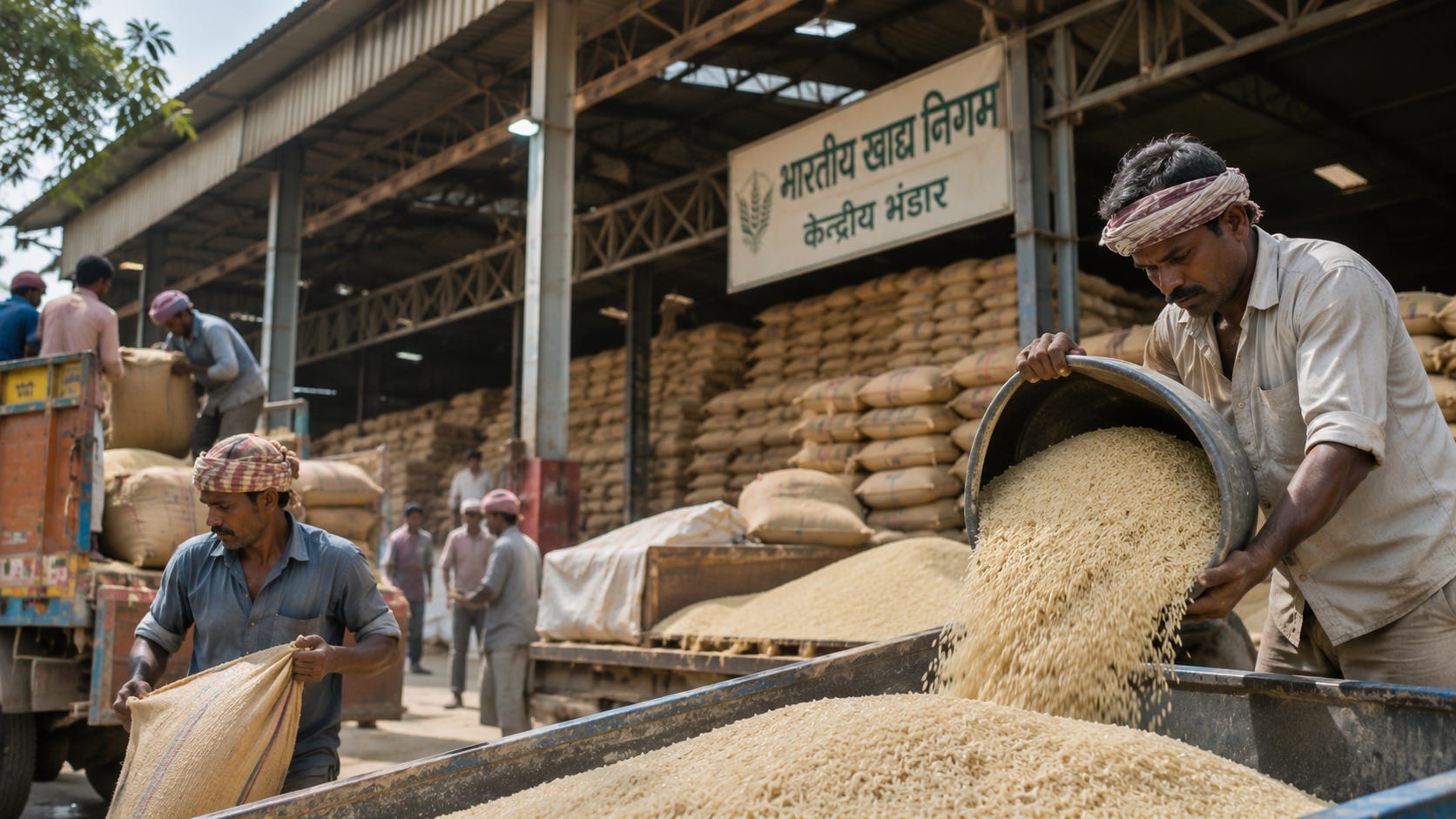
Centre doubles rice-sale target and mandates weekly stock disclosure
Key facts: Open-market rice-sale target raised from 25 lakh to 50 lakh tonnes; weekly disclosure required for traders, retailers and millers; five southern states authorised to impose stock limits where necessary. ¹
The government announced new measures on Friday to increase rice supplies and monitor stocks held by private businesses as concerns over food-price inflation persist.
Under the Open Market Sale Scheme (Domestic), the quantity of rice targeted for sale through government e-auctions during 2026–27 has doubled to 50 lakh tonnes, equivalent to five million metric tonnes.
The Food Ministry said 25 lakh tonnes had already been sold to private parties by 31 October, compared with 11 lakh tonnes during the corresponding period of the previous financial year.
The increase in the annual target is not a statement that another 25 lakh tonnes have already entered the market. The actual additional supply will depend on subsequent auctions and purchases.
A separate order requires traders, wholesalers, retailers, large retail chains and processors to report their rice and paddy stocks every Friday through the government’s Food Stock Portal.
Disclosure covers six categories, including basmati, premium non-basmati, parboiled and broken rice.
The Centre has also given Andhra Pradesh, Karnataka, Kerala, Tamil Nadu and Telangana permission to impose stock limits where considered necessary, until 31 January 2027. That authorisation does not mean identical limits have already been imposed in all five states.
Additional quantities of subsidised Bharat Rice will be distributed through NAFED, NCCF and Kendriya Bhandar.
Analysis: The measures combine additional market supply with closer monitoring of private inventories. Their effectiveness will depend on auction participation, the distribution network and production conditions. More government rice entering the market may help moderate prices, but the extent of any reduction remains uncertain.
Next milestone: Weekly stock declarations and further e-auctions will provide the first evidence of implementation. ²
India opens Semicon 2.0 applications and clears 12 component projects
Key facts: Semicon 2.0 fiscal outlay of ₹1,27,500 crore; 12 new electronics-component applications approved; ₹7,503 crore in proposed investment; 7,127 projected direct jobs. ³
Electronics and Information Technology Minister Ashwini Vaishnaw launched the application portal for the second phase of India’s semiconductor programme on Friday.
The new window accepts proposals covering semiconductor equipment and materials, fabrication facilities, and assembly, testing and packaging operations.
The programme’s ₹1,27,500-crore fiscal allocation had already been approved. Friday’s development was the opening of applications under three programme pillars, not a fresh allocation of that entire amount.
Separately, the Ministry approved 12 applications under the Electronics Components Manufacturing Scheme.
Those projects envisage ₹7,503 crore in investment and ₹39,045 crore in production, with an estimated 7,127 direct jobs.
Approved products include multilayer printed circuit boards, relays, heat sinks, copper foil, battery materials and specialty ceramics.
The projects are distributed across seven states.
With the latest approvals, the scheme has cleared 118 applications involving projected cumulative investment of ₹77,051 crore.
Government figures also show that five of the 12 semiconductor projects approved under the earlier programme had begun commercial production by October 2026.
Analysis: The latest approvals extend India’s manufacturing ambitions towards components, materials and production equipment rather than final-product assembly alone. But projected investment and employment are not realised outcomes. The decisive indicators will be factory commissioning, production volumes and domestic value addition.
Next milestone: Application assessment under Semicon 2.0 and execution of the newly approved component projects. ⁴
Indian equities record strongest weekly advance in nearly six years
Key facts: Nifty 50 closed Friday at 25,030.35; Sensex at 81,028.02; weekly gains of approximately 8.6% and 8.8%, respectively. ⁵
India’s benchmark equity indices completed their seventh consecutive session of gains on Friday, recording their strongest weekly performance since early 2021.
The Nifty 50 rose 2.01% on the day, while the Sensex advanced 2.17%.
The rally was supported by a decline in crude oil prices, renewed foreign investment and changing international market conditions following the US midterm elections.
Foreign investors purchased approximately ₹15,000 crore in Indian shares on Thursday alone, according to Reuters, their largest single-day net purchase in nearly six years.
Financial stocks were among the principal beneficiaries.
The contrast with other Asian markets was notable. Technology-heavy indices in South Korea, Japan and Taiwan fell sharply on Friday amid concerns about the financial returns expected from extensive investment in artificial intelligence infrastructure.
Indian benchmarks, which have less direct exposure to some of those capital-intensive investments, moved in the opposite direction.
Nevertheless, the week’s gains have not eliminated their weaker performance relative to broader emerging markets earlier in the year.
Analysis: Lower oil prices and returning foreign capital have improved sentiment towards Indian equities. A seven-session rally, however, does not establish a sustained change in earnings growth or investment flows. Global energy prices and the durability of foreign buying remain relevant risks.
Next milestone: Trading resumes on Monday, 9 November, when investors will assess international market developments and any changes in geopolitical expectations.
Iran and the US consider new proposals, but ceasefire conditions remain unresolved
Key facts: Qatar is mediating proposals involving nuclear negotiations; Iran maintains preconditions for talks; reopening the Strait of Hormuz remains disputed. ⁶ ⁷
Iran has conveyed a nuclear proposal to the United States through Qatar, according to a senior Iranian official quoted by Reuters. The official said Washington was reviewing the proposal but provided no details of a response.
The reported diplomatic contact follows months of conflict involving Iran, the United States and Israel, and continuing restrictions affecting shipping through the Strait of Hormuz.
Iranian officials have demanded measures including sanctions relief, the release of frozen assets and compensation for war damage before substantive negotiations begin.
Washington has maintained that nuclear issues must form part of initial discussions.
The Associated Press reported that mediators were examining confidence-building steps involving port access, inspections of Iranian nuclear sites and possible temporary arrangements for the strait.
Those measures remain proposals. No new ceasefire agreement or confirmed reopening of the waterway has been established.
The stakes extend beyond the region. The Strait of Hormuz is an important passage for international oil and gas supplies, including shipments serving Asian economies.
Analysis: The latest contacts indicate that diplomatic channels remain active despite significant differences over sequencing and conditions. For India, progress could affect energy-import costs and maritime trade. That potential benefit should not be mistaken for a negotiated outcome.
Next milestone: Official confirmation of any mutually accepted framework, followed by verifiable changes to maritime restrictions or nuclear-inspection arrangements.
The day ahead
7 November — Rice-stock measures: Businesses subject to the new disclosure order must comply with the weekly reporting framework. Further clarification of enforcement and state-level stock limits will be important.
Semiconductor manufacturing: Applications are open under Semicon 2.0’s equipment, fabrication and packaging pillars. Project approvals should be distinguished from completed production.
RBI reserves: Figures released Friday show India’s foreign-exchange reserves at $717.056 billion for the week ended 30 October, down $2.691 billion. The change includes currency-asset and gold-valuation movements; the weekly data alone do not establish how much resulted from market intervention. ⁸
Highway tolling: NHAI has issued design standards for barrier-free tolling on four-lane and wider national highways. The guidelines concern future and ongoing projects; they do not mean barriers have already been removed nationwide. ⁹
9 November — Markets reopen: Indian exchanges return after the weekend, with oil prices, foreign investment flows and overseas market developments in focus.
Explore The Raisina Post
Market Desk — Indian equities, currencies and commodity references.
Policy Monitor — Regulatory notifications and government announcements.
India in Data — Economic indicators and historical comparisons.
Sources
Ministry of Consumer Affairs, Food and Public Distribution, Government Doubles OMSS Rice Sale Target, 6 November 2026. Official release
Reuters, India Doubles Rice Sale Target as Price Concerns Loom, 6 November 2026. Read
Ministry of Electronics and Information Technology, Semicon 2.0 Portal Launched; 12 ECMS Applications Approved, 6 November 2026. Official release
Business Standard, Government Clears 12 ECMS Projects and Launches ISM 2.0 Portal, 6 November 2026. Read
Reuters, Indian Stocks Buck Global Technology Rout, Post Best Week in Six Years, 6 November 2026. Read
Reuters, Iran Sends Nuclear Proposal to United States Through Qatar, reported 5–6 November 2026. Read
Associated Press, Iran Reviews Proposals Focusing on Its Nuclear Programme, 6 November 2026. Read
Reserve Bank of India, Weekly Statistical Supplement: Foreign Exchange Reserves, 6 November 2026. Official data
Ministry of Road Transport and Highways, Guidelines for Multi-Lane Free Flow Tolling, 6 November 2026. Official release
Information cutoff: Approximately 4:20 a.m. IST, 7 November 2026.
Reporting note: This briefing draws on official government and central-bank publications alongside attributed international and financial reporting. Government targets are distinguished from realised results, and the reported US–Iran proposals are not presented as an agreement.

The next briefing, in your inbox
The Raisina Post’s Editorial Desk sends a clear account of the decisions, data and global moves shaping India each morning. Subscribe free, or share this edition with someone who follows the story.